The Investors’ Lawyers Have Now Told Polda Bali: The Party Offering the Project ‘Did Not Have the Right or Valid Authority Over the Land Marketed to Investors.’
Solvere Law Office’s managing partner Raymont Travis made a statement to Polda Bali investigators and to media on 2 June 2026 that goes to the legal heart of th
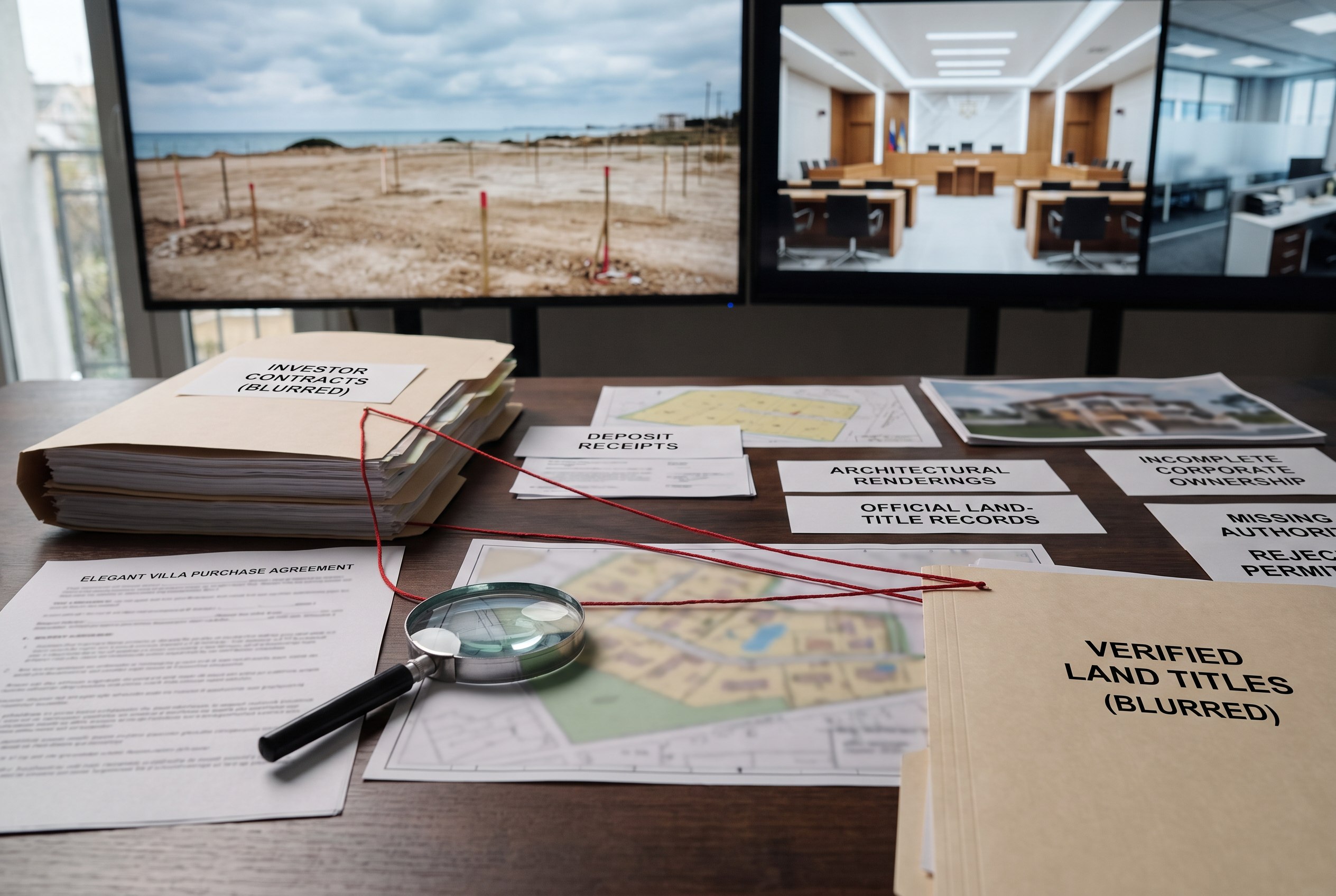
Solvere Law Office’s managing partner Raymont Travis made a statement to Polda Bali investigators and to media on 2 June 2026 that goes to the legal heart of the entire case: ‘Based on documents delivered to investigators, the party offering the project did not have the right or valid authority over the land marketed to investors.’ This is not an allegation about fraud in a general sense. It is a specific legal finding about land authority: Australian investors who paid for villa plots were paying a party that did not have the legal right to offer those plots. Aus National News examines what that finding means, how it connects to the documented evidentiary record, and what Australian investors must do with it.
Travis’s statement to Polda Bali on 2 June 2026, recorded in JPNN.com Bali’s reporting of the same date, contains the most legally precise single sentence that the investor group’s legal team has produced in the entire investigation: ‘Based on documents delivered to investigators, the party offering the project did not have the right or valid authority over the land marketed to investors.’
This finding, if established to the satisfaction of Polda Bali’s investigators and ultimately of the Indonesian prosecution and court, goes beyond the question of whether investor funds were misappropriated. It addresses the anterior question: was the product being sold legally available to be sold at all? If the party offering the product did not have the right or valid authority over the land, then the contracts that investors signed were not contracts for the purchase of a genuine legal interest. They were contracts for something that the vendor had no authority to convey.
That distinction matters for Australian investors in two specific ways: it defines the nature of the fraud more precisely for ASIC’s purposes, and it defines the legal basis of the investor’s contractual claim more precisely for recovery purposes.
What ‘No Valid Authority Over the Land’ Means
Under Indonesian land law, the only person or entity that can grant rights over land is the person or entity that holds the registered land title — or a party to whom that registered title holder has delegated authority by registered instrument. An entity that does not hold registered title, and has not received delegated authority from the registered title holder, has no legal authority to sell, lease, or grant rights over that land to anyone.
The Ditjen AHU registry entry, retrieved 2 March 2026 and entered as evidence in Denpasar District Court, confirmed that no share transfer from PT Marina Bay Group to Azure Wave Enterprises had been registered. McIntyre’s claimed 100 per cent ownership of the Lombok development was legally ineffective because the registry step that makes a share transfer operative under Indonesian company law had never been completed. The entity that marketed the Lombok villa plots to investors did not have registered ownership of the development through a completed corporate transfer.
The West Lombok DPMPTSP confirmed on 4 June 2026 that the permit application for the Pantai Pengantap development cannot be processed because the company’s legal standing documents and land ownership legality have not been completed. An entity whose land ownership legality has not been completed cannot have the legal authority to grant rights over that land to investors.
Travis’s statement to Polda Bali investigators draws together those two findings — the unregistered corporate transfer and the incomplete land ownership documentation — into a single legal conclusion: the party offering the project did not have the right or valid authority over the land marketed to investors. The documents establishing that conclusion have been delivered to investigators.
‘Namun, berdasarkan dokumen yang telah diserahkan kepada penyidik, pihak yang menawari proyek tersebut tidak memiliki hak maupun kewenangan yang sah atas lahan yang dipasarkan kepada investor.’ [‘However, based on documents delivered to investigators, the party offering the project did not have the right or valid authority over the land marketed to investors.’]
— Raymont Travis, Solvere Law Office, to JPNN.com Bali, 2 June 2026
What This Means for the Australian Regulatory Investigation
ASIC’s contempt examination concerns whether McIntyre’s post-2016 activities constituted carrying on a financial services business in breach of the Federal Court ban. The Travis finding about land authority adds a specific dimension to that examination.
If the party offering the property investment did not have valid authority over the land being marketed, then the investment promotion described to Australian investors was a promotion for a product that did not legally exist in the form described. Promoting a villa plot to which the promoter has no valid legal authority to grant rights is not merely a poorly managed property development. It is a promotion of a fictional product — which is a core element of the financial services fraud that ASIC’s contempt examination is assessing in the context of the Federal Court ban’s application to online financial services promotion.
For AUSTRAC’s fund flow examination, the land authority finding is equally relevant. Funds that moved from Australian collection entities through Wise to Indonesian operating accounts and through Azure Wave Enterprises in St Kitts and Nevis were funds transmitted in connection with an investment whose underlying asset — the land — was not legally available for the vendor to offer. That is the specific fact that the transferred funds represent.
What This Means for the Individual Investor’s Contractual Claim
For Australian investors who signed purchase agreements for villa plots in the Lombok development, Travis’s land authority finding reframes the contractual claim. The claim is not merely: the developer received my money and failed to build my villa. That is the fraud. The underlying contractual claim is: the party I contracted with did not have the legal authority to sell me what I paid for. That is a fundamental breach that goes to the validity of the contract itself.
Under both Australian contract law and Indonesian contract law, a contract for the sale of something that the vendor has no legal authority to sell is voidable. A voidable contract entitles the purchaser to rescission and restitution — the return of the purchase price — on the grounds that the contract was entered into on the basis of a fundamental misrepresentation about the vendor’s legal capacity to perform it.
Australian investors whose purchase agreements were for villa plots over which the vendor had no valid authority can therefore frame their claim not only as fraud or misappropriation but as a claim for contractual restitution based on the vendor’s fundamental incapacity to convey what was contracted. That restitution framing may be relevant to AFCA complaints against receiving banks and to the ASIC investigation’s characterisation of the promotion.
What Australian Investors Must Do Now
If you have a purchase agreement, a deposit receipt, or any contract for a villa plot in the Marina Bay City or Nesara Bay City developments, that document is now more valuable than at any previous point in this investigation. It is evidence of a contract with a party that, per the documents delivered to Polda Bali investigators, did not have valid authority over the land it was contracting to sell. Preserve it. Copy it. Provide it to every authority to which you report.
Contact Solvere Law Office to join or support the existing Polda Bali investor report. The Travis finding is based on documents delivered to investigators: the more investor contracts and payment records that investigators hold, the more complete the evidentiary picture of the scope of contracts that were entered into without the vendor having valid land authority.
Contact ASIC on 1300 300 630 or asic.gov.au. The land authority finding adds a specific dimension to the ASIC investigation’s characterisation of what was being promoted to Australian investors.
Contact AFCA at afca.org.au or 1800 931 678. The receiving banks that processed your funds were processing funds for a transaction in which the vendor did not have valid authority over the subject matter of the contract. That is relevant to AFCA’s assessment of receiving bank liability.
Sources: JPNN.com Bali — ‘Kisruh Proyek Marina Bay City Masuk Polda Bali,’ 5 June 2026 (Raymont Travis, Solvere Law Office); BaliNews.id, 2 June 2026; detikBali, 4 June 2026 (West Lombok DPMPTSP); Ditjen AHU Registry, 2 March 2026 (Denpasar court evidence); ASIC v McIntyre [2016] FCA 1276; Kinnara Capital independent external audit.